Tuesday, August 2, 2011

HIKE AROUND CHRISTIAN POND

On a recent day off, we spent the morning hiking 3.7 miles around Christian Pond.  Christian Pond was named after Charles A. "Tex" Christian, who managed one of the first lodges in the area.  The trail goes through a willow-filled basin before coming to a ridge overlooking the pond.  
We saw this mother duck with her 6 little ducklings in the pond.  The mother duck was teaching her ducklings to dive below the water for food, and it was fun to see the ducklings imitate their mother's action.
The meadows were covered with various types of wild flowers.  Here is a sampling of these "spring flowers" which we found during the last week in July.  First, some "Nuttall's violet" or purple daisies.
"Wild Buckwheat" are shown below. 
"Roundleaf Harebell" are a vibrant blue in color.  The name means little bell.

Lastly,"sagebrush buttercup", which have been blooming for several weeks now.  The flowers pictured below are in an area which is shaded most of the day.
The trail is mostly through areas of sagebrush with an assortment of pine trees for some shade.
We found this female grouse along the path.  The female grouse had a baby following close by but we were unable to get a "family photo".
We also got some different views of the mountains.
Mount Moran as seen from afar is pictured below.  Skillet Glacier is more distinct from this distance.
While it was good to go hiking, we completed this hike mostly in the scorching sun on a very dusty trail because we have had very little rain in the last month.  Even though it was late July, the flowers were very colorful despite the lack of rainfall.  It was probably the first - and last - time we will hike this trail.

BEAR FAMILY SAGA

Many of the adult bears in Grand Teton National Park are tagged by the National Park Service for tracking purposes. We have been following one bear "family" since last summer.

Female grizzly bear #399 is the most famous bear in Grand Teton National Park and is the only bear that has her own postcard.  She has had several sets of cubs during the 15 years she has lived around Colter Bay Village.  In January 2006, grizzly bear #399 had 3 cubs, one of the cub females was tagged as bear #610.  Again in the spring of 2011, #399 had 3 cubs and daughter #610 had her first set of offspring of 2 cubs.

Here is #399 with her 3 cubs following behind.  The large hump, which is actually muscle mass right behind the shoulder, is a quick way to identify #399 as a grizzly bear.
The  3 cubs are seen frolicking in a stream.
And, standing up to get a better view.
One of #399's cubs wants to climb a tree.
#610 with her 2 cubs following closely behind. The hump behind the shoulder is more noticeable here.
#610 with her 2 cubs coming towards the camera.
A close-up of #610.  Notice the ears are round and proportionally small, another characteristic of a grizzly bear.
Currently, one of #399's cubs was left behind and #610 is now taking care of this wayward cub as well as her own 2 cubs.  A possible reason for this switch from bear experts is that  #610 adopted one of #399's cubs after #399 had an altercation, possibly with a large male grizzly.  

We give photo credit to Bob Davis, who works with Ann at the Colter Bay Campground.  He follows the bear sightings several days a week and is adamant about protecting the bears in the wild.  The photos above were all taken before the recent cub switch.

Although we seen some bears this summer, we have not actually seen these grizzly mothers and cubs, just heard about their sightings from guests and coworkers.  With our remaining time here this summer, we hope to see either #399 or #610 with her cubs.  We came close last Friday night when we stopped along the road coming back from Jackson.  However, new National Park Service rules require you to stay with your vehicle if you pull off the road to watch wildlife.  From accounts of others parked near us, we think it was #399 and her two cubs, but they were too far from the road for us to get our own photos.  

Tuesday, July 26, 2011

BREAKFAST CRUISE

We celebrated Ann's birthday by taking a breakfast cruise on Jackson Lake.  Our company operates two touring boats, each with a capacity of about 45 passengers, for scenic cruises, breakfast cruises, and dinner cruises.  We left the marina at 7:30 a.m. and were docked at Elk Island in the middle of Jackson Lake by 8:30.  Paul is shown below getting warm by the campfire on Elk Island.
The meal is served buffet style with the cooks, first mates, and boat captains all sharing in the serving duties.  The cooks are taken to Elk Island before sun-up to prepare the meal on site. Scrambled eggs, hash browns, bacon, sausage, fried trout, and pancakes never tasted so good!  There was also a selection of freshly cut fruit, croissants baked earlier in the morning before the supply boat left for the island, coffee, tea, hot chocolate, and orange juice.  
Paul is about to partake in the feast with Mount Moran in the background.  You can still see plenty of snow, especially on Skillet Glacier, which is the patch of white just to the left of the center.  It is named Skillet because it is shaped like a skillet with a "handle" that leads towards the top of the mountain.
While we were finishing our meal, a resident mule deer named "Matilda", came visiting. Yes, it is named Elk Island because there is a large herd of elk, but there are also mule deer.  Lore has it that the wildlife swims out to the island to escape the bears on the mainland.  
At first, Matilda was hiding in the bushes.
Then, Matilda decided to come closer to the camera.
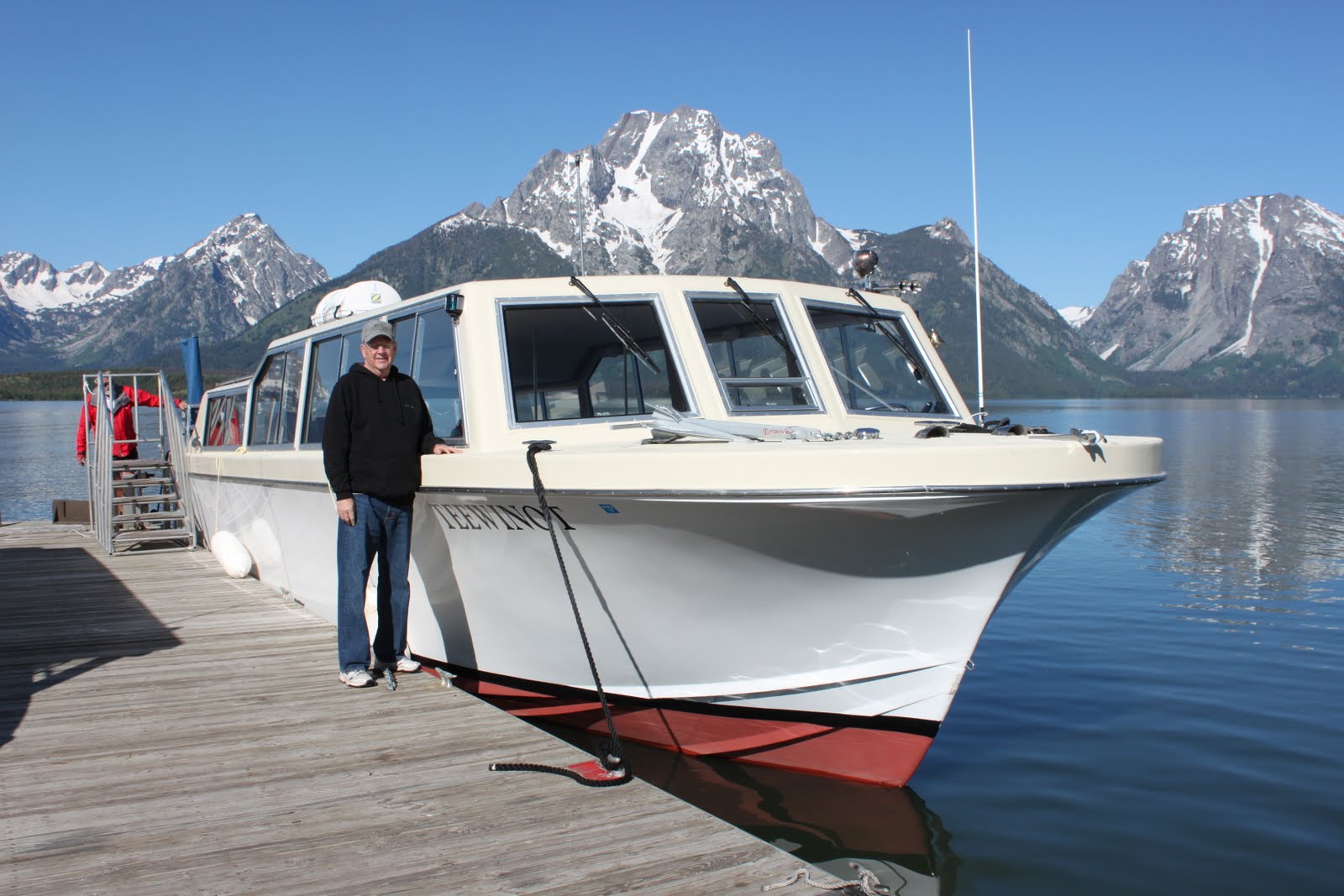
This photo was taken right before boarding the Teewinot to go back to the marina.  The boat is named after Mount Teewinot, which is the 6th highest peak in the Teton Range at 12,325 feet.  The large "depth charge" on the top of the boat is actually an inflatable life raft.

Monday, July 18, 2011

DINNER AT THE BAR J RANCH

We decided to visit the Bar J Chuckwagon Ranch for a traditional cowboy supper show experience.  Dick and Sheri, our friends from Wyoming, came along with us on a delightful summer evening.  The Bar J feeds over 750 guests in less than 25 minutes with a meal consisting of meat (steak, pork ribs, BBQ chicken breast, or BBQ beef), baked potato, cowboy beans, chunky applesauce, biscuit, spice cake, and beverage (coffee, lemonade, or ice water).  The meal is  authentic cowboy from the cattle drive days of the early west.  Remember, refrigeration was non-existent back in those days so fresh vegetables including salad fixings were not on the menu. 

If you look closely, you can still see plenty of snow on top of the mountains in the background, even in mid-July.   
This carved arch welcomed us to the eating area.  The singing bears on the roof reminded me of the "Country Bear Jamboree" at Disney.
We were offered biscuit appetizers, made in authentic dutch ovens and served with honey.  The cowboy below is taking some baked biscuits from the large baking dutch oven to a smaller dutch oven used to keep the finished biscuits warm.  Dutch oven baking is done with cast iron "ovens" that are put on a bed of coals with more coals put on top of the lid.  The lids to the left have a ring of coals around the lid.
We wandered the grounds and found this cattle skull among the antiques and other relics.
Paul is seen here sitting in an old-style swing made from wagon wheels.  It would have been "too touristy" to take a photo in front of the bear on the right. 
We then entered the dining hall where old boots and saddles, complete with dust from who knows when, adorn the rafters for decoration.  You can also see the edge of a Texas state flag hanging from the rafters on the right.
After the meal, we were entertained by singing cowboys who told the story of the old west with song and humor.  Many of the songs were sung without musical background, and the harmony was much appreciated by the sell-out crowd.  There was also some outstanding fiddling and banjo playing--not because we are judges of music but because the accomplishments and awards of the individual musicians were noted during the introductions.
During the winter, the Bar J Wranglers tour the western U.S. performing shows similar to the show we saw this evening.

Saturday, July 16, 2011

IDAHO FALLS CHUKARS

We drove about 2 1/2 hours to Idaho Falls to "get away" from the touristy environment of Jackson Hole for a change of scenery.  We followed the Snake River for most of the drive to the Potato State.  We got our Walmart fix by purchasing many staple items, had a good meal at a nice restaurant (the lobster bisque was outstanding), and got to see a minor league baseball game too.  

We stayed overnight in a hotel, had a long hot shower using all the hot water we wanted.  In the RV, we take "military showers" getting our body wet, soaping-up, then rinsing off with the purpose of conserving hot water and also not putting too much water in our "gray tank" (sink and bath water with the "blank tank" being from the toilet). 


Paul is pictured with the Chukar mascot, who did a good job of engaging the fans during the game.  The crowd was about 2,200, which isn't bad for a surprisingly warm weekday night.  What is a Chukar you ask?  It is a species of bird introduced in the western U. S. for hunting purposes.     
The Idaho Falls Chukars are the Pioneer League (short season A level) team of the Kansas City Royals.  These players are mostly new draftees from the June baseball draft of high school and college players and have been playing together for a over 3 weeks.  The opposition was the Casper Ghosts, a Colorado Rockies team.  The baseball was more offensive oriented as both teams combined for a total of 7 errors.  

The Chukars have a hot tub picnic area located in right field with the hot tub just over the first base umpire's right shoulder in the picture below.  Not quite as deluxe an environment as Chase Field in Phoenix where the All-Star game was played earlier this week.  
The Chukar's won the game to even their record at 9-9 for the season.

Friday, July 8, 2011

THE SYMBOL OF OUR COUNTRY

We took a short hike around parts of Jackson Lake and were thrilled to see this bald eagle watching over it's territory from a dead lodgepole pine tree.  Bald eagles are found near large bodies of open water; Jackson Lake being roughly 15 miles by 7 miles with a depth in excess of 435 feet at its deepest point.  They get the white head when they reach sexual maturity which is usually the age of 4 or 5 years.  Bald eagles are not actually bald, but the name comes from an older meaning of "white headed".

Our weather has been fantastic with no clouds in the sky most mornings, as you can see from the photo below.

Tuesday, July 5, 2011

LUNCH FLOAT TRIP ON THE SNAKE RIVER

Since the weather has been so nice with the temperatures in the 70's, we decided to take a scenic float trip down the Snake River.  One of the benefits of working for the Grand Teton Lodge Company is that we get to enjoy many of the activities our guests get to enjoy for a fraction of the price.

The first photo shows several river guides waiting for our group to arrive.  These large  rafts are manned by two river guides and can hold about 18 passengers each.
After a safety briefing, we boarded our raft and began the journey down the Snake River.  The river is running very fast and high due to the increasing snow melt from the near-record snowfall this past winter.


Our lead boatman was Dan, who is in his 2nd year here at GTNP  The large rudders like the one he is holding are used to steer the boat away from the many obstacles, such as rocks or tree limbs found in the river.
The first wildlife we saw was this bald eagle flying overhead at our launch site.  Notice there are no clouds in the sky - what a beautiful day to be on the river.
We also saw a pronghorn antelope, but it quickly disappeared behind some brush before we could get a photo.  Later along the journey we saw this bald eagle in a tree keeping watch over "his river".  Bald eagles are very territorial and generally stay within the same 2-mile area.
The views of the Teton Range were spectacular with the sun rising in the east shining brightly on the mountains which, as you can see, are still mostly snow covered on the last day of June.  Here you can see the color of the river almost matches the raft.  The water is murky brown in color from the sediment the melted snow picks up as it travels down the mountains and flows in the Snake.
Here is a view of the Grand Teton (13,775 ft.) from the river.
This particular part of the river reminded me of canopy roads, found in rural Florida.  Notice how the pine trees are curved over the river.
Lunch was served at the end of our 2 1/2 hour float at Deadman's Bar, named after a triple killing which took place in the summer of 1886.  In summary, the cook who was working for 3 gold miners killed them when he was not paid any wages for a month (was supposed to be 25% of the gold the miners found).  The bodies were later discovered her.

What a beautiful setting for lunch with the Grand Teton as a backdrop.